



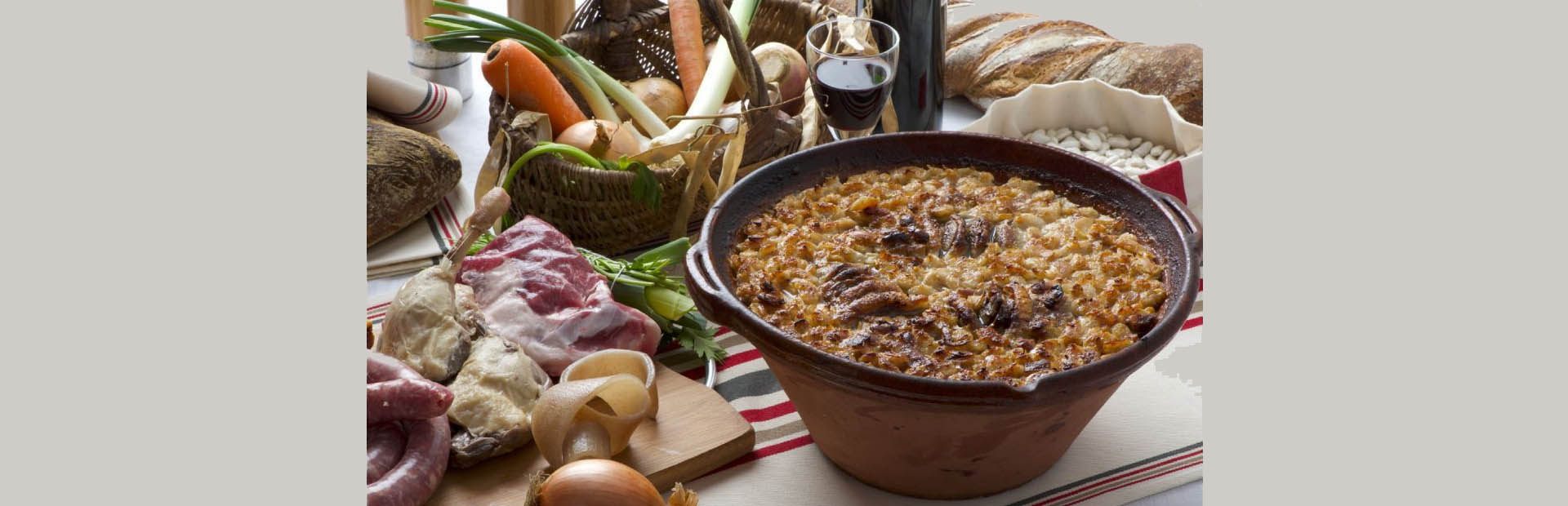
It's now time to get down to business, and since winter is still with us, we want that business to be hearty, rustic and satisfying! According to the French National Agency for Food Safety, the French don't eat enough legumes, which is a shame. Besides being delicious and versatile, they come with plenty of other advantages: essential nutrients, environmental benefits, ease of storage, and more.
Of course, let's be honest — the discomfort they can cause some people is sometimes enough to put them off. Big mistake! And since Valentine's Day is behind us, we suggest making peace with the tarbais bean all week long, through a flagship dish of Southwestern French cooking... Cassoulet, in its original form or reinvented. Because when it's good, it's good.
And to start on the right foot, it's worth revisiting the fundamentals: the traditional cassoulet presented by the chef of the Hôtel Restaurant du Midi in Revel (31), Bernard Aymès. As he points out, cassoulet is a popular dish that has evolved over the years too, served as a main course or a starter, reinvented according to tastes and trends. When it was first created, cassoulet was a simple, practical dish that could be cooked ahead of time and then taken to the baker's to be gratinéed, keeping alive a tradition dating back to the Middle Ages. "I only make my cassoulet with tarbais beans, because I want it to have a certain body. A quality cassoulet is, above all, a broth in which you can really feel the tarbais bean soaking up all those flavours while keeping its bite and texture." Allow one night's rest, one hour of preparation and two hours of cooking.
Bernard Aymès' recipe, restaurateur in Revel
Ingredients for 6 people
- 600g tarbais beans
- Ham rind, as needed
- 100g confit duck leg
- 100g pork sausage
- 50g pork rind sausage
- 100g pork ribs
- Onions, garlic, bouquet garni (as needed)
- Ham and pork belly (as needed)
- 2L meat or poultry stock
- 1/2L Payrole stock
- Salt, pepper, duck fat (as needed)
The recipe
The day before: soak the tarbais beans overnight in roughly three times their volume of cold water.
The next day: blanch the tarbais beans with the pork rind until boiling, then drain. Brown the sausage and deglaze at the end of cooking to recover the cooking juices. Sauté the diced ham, pork belly, chopped onions, minced garlic and pork ribs. Season, then add the stock and Payrole stock, along with the bouquet garni. After 20 minutes of cooking, set the pork ribs aside and add the soaked tarbais beans, covering with liquid, then cook for about 45 minutes, making sure they stay firm. Layer all the ingredients into the cassole dishes, cover with the cooking juices and add a spoonful of duck fat on top. Bake at 240°C (gas mark 8) for 30 minutes until a crust forms (gratin effect).
The chef's tip
The tarbais beans can be soaked the night before in a bath of cold water roughly three times their volume, with an optional pinch of food-grade bicarbonate of soda added overnight (to reduce digestive discomfort).
7 de Table blog — Official website